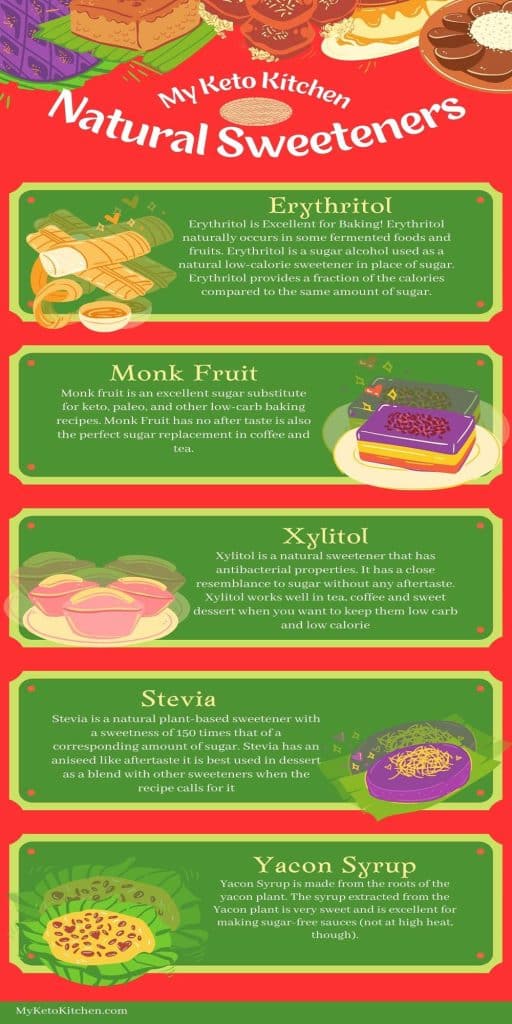
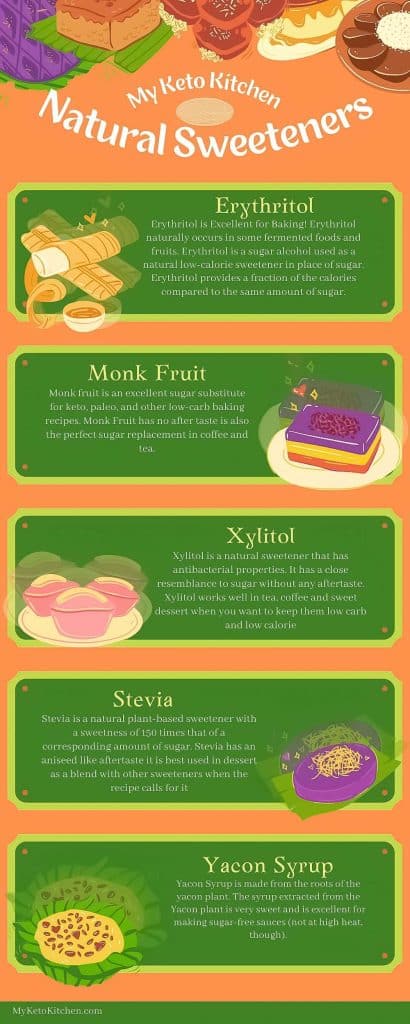
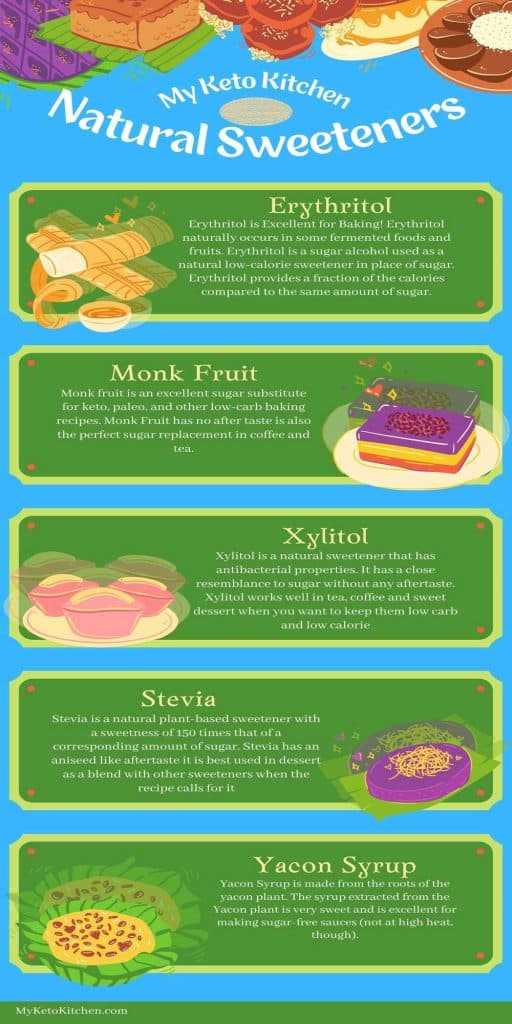
Keto sweeteners let you bake, cook, and sweeten drinks without spiking blood sugar or knocking yourself out of ketosis. The challenge is that different sweeteners behave very differently in the oven — some dry out baked goods, some crystallize on cooling, some caramelize like sugar, and some are so intensely sweet that using the wrong amount ruins the recipe. This guide covers everything you need to know to pick the right sweetener for the job: what each one does, when to use it, what to avoid, and how to convert between them.
I’ve been using keto sweeteners in recipes on this site for years. My go-to for most baking is an erythritol-stevia blend — it bulks well and doesn’t leave much aftertaste when balanced properly. I’ve also done a lot of testing in the van kitchen where I have limited ingredients and can’t afford a batch that doesn’t work, so I’ve learned quickly which sweeteners are forgiving and which aren’t. Allulose is the one I wish I’d started using sooner — it solves the moisture problem that erythritol creates in cakes and cookies. More on that below.
Below you’ll find a breakdown of each keto sweetener with honest notes on taste, texture, and baking behavior; a comparison table covering glycemic index, sweetness, calories, and best use cases; a sweetener conversion reference so you can swap them in any recipe; and a list of sweeteners to avoid on keto with explanations for each.
At a glance
The Best Keto Sweeteners for Baking
1. Allulose
Allulose is the sweetener that most closely mimics how sugar actually behaves in baking — it dissolves fully, browns like sugar, caramelizes, and most importantly, retains moisture in baked goods. If you’ve ever made keto cookies that came out dry or cake that crumbled, erythritol is usually the culprit. Allulose solves that problem.
What is Allulose?
Allulose is a rare sugar — a monosaccharide that occurs naturally in small amounts in figs, raisins, and wheat. Despite being chemically similar to fructose, the body doesn’t metabolize it, so it passes through without raising blood glucose or contributing usable calories. It has zero net carbs and is FDA-approved as safe.
Is allulose keto-friendly?
Yes. Allulose has no impact on blood sugar or insulin. At about 70% the sweetness of sugar, you’ll use slightly more than a 1:1 ratio — a practical starting point is 1.25 cups allulose per 1 cup sugar, though many recipes work fine at 1:1.
Allulose baking behavior:
The advantages over erythritol are real and practical. Allulose locks in moisture, so cookies stay chewy and cakes stay soft. It caramelizes and browns properly, which matters for anything where color and texture are part of the result. It doesn’t crystallize when it cools, which makes it the right choice for, baked custard, ice cream, puddings, and no-bake cheesecakes where erythritol leaves a gritty texture.
One caution: allulose browns faster than sugar in the oven, especially at higher temperatures. Watch your bake times closely — reduce temperature by 25°F or tent with foil if edges are browning before the center sets.
- Zero net carbs, zero glycemic impact
- Dissolves, caramelizes, and browns like sugar
- Best choice for moist baked goods, ice cream, sauces
- About 70% as sweet as sugar — use slightly more than 1:1
- Watch for faster browning at high heat
- More expensive than erythritol; less widely available in stores
2. Erythritol
Erythritol is the workhorse of keto baking. It’s widely available, relatively affordable, has a clean taste without much aftertaste, and works well in anything where you want a firm, slightly crumbly texture — cookies, crackers, crumble toppings, biscotti. It’s our most-used sweetener in the MKK recipe collection alongside erythritol-stevia blends.
What is erythritol?
Erythritol is a sugar alcohol that occurs naturally in small amounts in some fruits and fermented foods. Commercially, it’s produced by fermenting glucose with yeast. It has roughly 70% the sweetness of sugar and provides almost no usable calories — the body absorbs most of it in the small intestine and excretes it unchanged, which is why it has a much better GI tolerance profile than other sugar alcohols.
Is erythritol keto-friendly?
Yes. Erythritol has a glycemic index of 0 and no impact on blood glucose or insulin. It’s safe to use liberally without concern about ketosis.
Erythritol baking behavior:
The key limitation of erythritol is that it is not hygroscopic — it doesn’t attract or retain moisture. This means it tends to dry out baked goods, particularly cakes, muffins, and anything where a soft or chewy texture matters. It also has a tendency to re-crystallize after cooling, which can produce a slightly gritty mouthfeel in frostings or chilled desserts.
There’s also a cooling sensation — some people notice a mild mint-like sensation on the tongue, particularly in recipes where erythritol is used in high concentrations. Blending with stevia or monk fruit extract reduces this considerably.
Granulated vs. powdered erythritol:
Use granulated erythritol for cookies, crumbles, and anything with a dry or crunchy texture. Use powdered (confectioners’) erythritol for frostings, glazes, and cheesecake bases — it blends more smoothly and avoids grittiness.
A note on the 2023 erythritol cardiovascular study: a study published in Nature Medicine raised questions about a potential link between high erythritol blood levels and cardiovascular risk. Worth being aware of, but the study measured blood levels after large doses and has limitations. If you’re concerned, allulose or monk fruit blends are good alternatives. I’m not removing it from the recommended list, but it’s fair information to have.
- Widely available and affordable
- Glycemic index 0, no insulin response
- Best for cookies, crackers, crumbles — anything dry or crunchy
- Use powdered form for frostings and glazes
- Can dry out moist baked goods — blend with allulose to compensate
- Cooling sensation in high concentrations — blend with stevia or monk fruit to reduce
3. Monk Fruit Sweetener (Luo Han Guo)
Monk fruit extract is one of the cleanest-tasting keto sweeteners — no aftertaste, zero calories, zero glycemic impact. The catch is potency: pure monk fruit extract is 200–300 times sweeter than sugar, which makes it nearly impossible to use alone in baking without over-sweetening. In practice, almost all “monk fruit sweeteners” sold for baking are monk fruit blended with erythritol or allulose, which gives the blend practical bulk and a 1:1 sugar ratio.
What is monk fruit?
Monk fruit (siraitia grosvenorii, also known as luo han guo) is a small melon grown primarily in southern China. The sweetness comes from compounds called mogrosides, which are extracted from the dried fruit. The FDA recognizes monk fruit extract as generally safe.
Is monk fruit keto-friendly?
Yes. Pure monk fruit extract contains no carbohydrates and has no effect on blood sugar or insulin. Monk fruit blends (erythritol or allulose base) are equally keto-safe — check the label for the base ingredient to understand the baking behavior you’ll get.
Monk fruit baking behavior:
Pure extract: suitable only for drinks and sauces where you need very small amounts. A few drops is enough for a large batch.
Monk fruit + erythritol blend (e.g., Lakanto): behaves like erythritol in baking. Same drying tendency, same cooling sensation risk, same powdered vs. granulated considerations. Good 1:1 substitute for sugar by volume.
Monk fruit + allulose blend: behaves like allulose — retains moisture, browns, caramelizes. Better for soft baked goods than the erythritol-based version.
- Zero calories, zero glycemic impact
- Cleanest taste of all the options — no notable aftertaste
- Pure extract is too potent for baking; use blends
- Blends behave like their base sweetener (erythritol or allulose)
- Generally more expensive than plain erythritol
4. Stevia
Stevia works well in drinks, some sauces, and as a blending agent to reduce the amount of erythritol or xylitol needed in baked goods. Used alone in baking, the aftertaste becomes pronounced and the lack of bulk creates texture problems. Used as part of a blend, it’s excellent — it punches up sweetness at very low volumes, which reduces the total amount of other sweeteners needed.
What is stevia?
Stevia is extracted from the leaves of Stevia rebaudiana, a plant native to South America. The active sweet compounds are steviol glycosides. It’s approximately 150–300 times sweeter than sugar depending on the extract quality.
Is stevia keto-friendly?
Yes. Stevia has no carbs, no calories, and no impact on blood glucose or insulin. It contains small amounts of magnesium, zinc, potassium, and B3.
Stevia baking behavior:
The aftertaste — often described as slightly anise-like or bitter — is the main practical issue. It’s highly noticeable in plain applications (unsweetened coffee, simple syrups) but becomes less prominent when blended with erythritol. Liquid stevia drops work better in drinks than powdered stevia, with a cleaner flavor and no bulking agents.
Don’t try to use stevia as a solo sugar substitute in baked goods — there’s no bulk, which affects structure, and the aftertaste concentrates in the final product.
- Zero calories, zero glycemic impact
- Very high sweetness — a little goes a long way
- Notable aftertaste when used alone — blend with erythritol or allulose
- Best uses: coffee and tea, blended sweetener formulas, sauces and dressings
- Available as liquid drops, powder, or granules (different behaviors in recipes)
5. Xylitol
Xylitol has a sweetness almost identical to sugar and a reasonable baking behavior — it measures 1:1, dissolves well, and doesn’t have the cooling sensation that erythritol does. It’s been used in dental products for decades due to its antibacterial properties. The practical downsides are GI sensitivity in higher doses and a critical safety note if you have pets.
What is xylitol?
Xylitol is a sugar alcohol derived from plant sources — most commonly birch wood or corn cobs. It’s widely used in sugar-free gum and oral care products due to its ability to inhibit the growth of Streptococcus mutans, the bacteria primarily responsible for tooth decay.
Is xylitol keto-friendly?
Xylitol has a glycemic index of 13 — not zero, but significantly lower than sugar (GI 65). For strict keto, this warrants caution in large amounts. It’s reasonable in small quantities for desserts and beverages but shouldn’t be your primary sweetener if ketosis is the priority.
Critical note: Xylitol is highly toxic to dogs (and potentially other pets). Even small amounts can cause a dangerous drop in blood sugar and acute liver failure. If you have pets in the house, keep xylitol products well away from them and be careful about scraps and drips.
GI tolerance: doses above around 30–50g can cause digestive upset in many people. Use it sparingly.
- Near-identical sweetness to sugar, 1:1 ratio
- GI of 13 — technically not zero, use in moderation
- Good baking behavior — no cooling sensation
- Antibacterial properties — useful in gum and dental products
- Toxic to dogs and potentially other pets — handle carefully
- Can cause GI upset in large doses
6. Natvia (Erythritol + Stevia Blend)
Natvia is a branded blend of erythritol and stevia that’s widely available in Australia, New Zealand, and the UK, and can be ordered from Amazon in the US. It performs well in baking — the erythritol provides bulk and structure while the stevia brings the sweetness up to a near-1:1 ratio with sugar without needing the full erythritol volume. The stevia aftertaste is present but softened by the blend.
This is a go-to for many of the MKK baked recipes — particularly anything crumbly or crisp. For moist baked goods like cakes or muffins, you’ll still run into erythritol’s drying tendency, so consider substituting allulose for half the Natvia in those cases.
7. Swerve (Erythritol + Oligosaccharide Blend)
Swerve is an erythritol blend that uses oligosaccharides (prebiotic fiber sourced from chicory root and other plants) instead of stevia. The result is a product with no aftertaste and sweetness equal to sugar 1:1. It performs identically to granulated sugar in most recipes by volume. It’s more widely available in the US than Natvia and is a common substitute in MKK recipes when Natvia isn’t available.
Oligosaccharides are fiber carbohydrates the body doesn’t absorb, so they don’t count toward net carbs and have no impact on blood glucose.
8. Yacon Syrup
Yacon syrup is extracted from the roots of the yacon plant (native to South America) through an evaporation process similar to how maple syrup is made. It’s high in fructooligosaccharides (FOS), which are prebiotic fibers that feed beneficial gut bacteria. A 2009 clinical study found yacon syrup contributed to weight loss and improved insulin sensitivity in obese patients.
The key limitation: yacon syrup cannot be used in high-heat cooking. Fructooligosaccharides break down above boiling point (212°F/100°C), rendering the sweetness unpredictable and negating the FOS benefit. Use it in sauces, dressings, smoothies, or anywhere it won’t be exposed to direct heat above a simmer.
Also high in potassium and antioxidants.
Keto Sweetener Comparison: Glycemic Index, Sweetness, and Calories
| Sweetener | Glycemic Index | Sweetness vs Sugar | Cal/tsp (approx) | Best Use |
|---|---|---|---|---|
| Allulose | 0 | 70% of sugar | ~0.4 | Moist baked goods, ice cream, sauces, caramel |
| Erythritol | 0 | 70% of sugar | ~0.4 | Cookies, crackers, crumbles, crunchy textures |
| Monk Fruit (pure) | 0 | 200–300× sugar | ~0 | Drinks, small doses only |
| Monk Fruit + Erythritol (e.g. Lakanto) | 0 | Equal to sugar | ~0.4 | Any baking — behaves like erythritol |
| Stevia (pure extract) | 0 | 150–300× sugar | ~0 | Drinks, blending agent in recipes |
| Xylitol | 13 | Equal to sugar | ~10 | Baking, drinks — moderate amounts only |
| Natvia (erythritol + stevia) | 0 | Equal to sugar | ~0.4 | Baking — most recipe types |
| Swerve (erythritol + oligosaccharides) | 0 | Equal to sugar | ~0.4 | Baking — most recipe types, no aftertaste |
| Yacon Syrup | ~1 | ~50% of sugar | ~7 | Sauces, dressings, no-heat recipes only |
| Table Sugar | 65 | Reference (1×) | ~16 | Avoid on keto |
| Maltitol | 36 | ~75% of sugar | ~10 | Avoid — not keto-friendly |
Sweetener Conversion Reference: How to Substitute in Recipes
When a recipe calls for sugar or a specific sweetener and you want to swap it, use this table. Note that this covers volume conversions — weight-based baking may need adjustment since density differs between sweeteners.
| If recipe calls for | Use this amount of erythritol | Use this amount of allulose | Swerve / Natvia / Lakanto |
|---|---|---|---|
| 1 cup sugar | 1¼ cups | 1¼ cups | 1 cup (1:1) |
| ½ cup sugar | ⅔ cup | ⅔ cup | ½ cup |
| ¼ cup sugar | 5 tbsp | 5 tbsp | ¼ cup |
| 1 tbsp sugar | 1¼ tbsp | 1¼ tbsp | 1 tbsp |
| 1 tsp sugar | 1¼ tsp | 1¼ tsp | 1 tsp |
| 1 cup Swerve | 1 cup | 1 cup | 1:1 between these |
Stevia conversions vary widely by brand and form (liquid drops vs. powder vs. packets), so check the product label. A general starting point for pure stevia powder: use ¼ tsp per 1 cup sugar and adjust to taste.
Free Printable Keto Sweetener Conversion Chart
The chart below covers every keto sweetener covered in this guide — how much to use instead of sugar, glycemic index, sweetness level, and best uses. Download it to keep on hand for whenever you’re adapting a recipe.
Can’t see the chart? Download the PDF directly — no email required.
Which Keto Sweetener to Use: By Recipe Type
The single most practical question is not “which sweetener is best” but “which sweetener is best for this specific recipe.” Different formats have different requirements.
Cookies: Erythritol-based blends (Swerve, Natvia, Lakanto) work well for a slightly firm, crisp texture like in our shortbread cookies. If you want chewy cookies, swap half the erythritol blend for allulose — it retains moisture and prevents the dried-out result that pure erythritol can produce.
Cakes and muffins: Allulose or an allulose-monk fruit blend gives the best result. The moisture retention makes the crumb softer and more like a regular cake. Erythritol alone tends to produce a dense, slightly dry result.
Frostings and glazes: Use powdered (confectioners’) erythritol or a powdered blend. Granulated erythritol won’t dissolve properly and will leave a gritty texture. Swerve Confectioners is a good ready-made option.
Ice cream and frozen desserts: Allulose is the clear winner. Erythritol crystallizes when cold, which makes it gritty in ice cream or frozen cheesecake. Allulose stays soft and scoopable.
Caramel and toffee: Allulose is the only keto sweetener that truly caramelizes like sugar. Erythritol doesn’t properly caramelize — it melts but doesn’t brown the same way and often re-crystallizes on cooling.
Sauces and dressings: Liquid stevia drops, monk fruit drops, or yacon syrup (no high heat). Powdered erythritol also works in warm sauces.
Coffee and tea: Liquid stevia drops or liquid monk fruit drops. Much cleaner than adding granulated sweeteners, which can leave residue at the bottom of cold drinks.
Sweeteners to Avoid on Keto
Any sweetener that raises blood glucose or spikes insulin can interrupt ketosis — even those marketed as “natural” or “low carb.” These are the ones worth avoiding:
Maltitol — the biggest trap in low-carb products. It has a glycemic index of around 36, which meaningfully raises blood sugar. Manufacturers use it because it’s cheap and sweet, and it’s often hidden in protein bars and “sugar-free” chocolate. It doesn’t legally need to be counted in net carbs on US labels, but it does need to be listed as an ingredient. If you see maltitol in an ingredients list, put it back.
Coconut sugar — marketed as a healthy alternative but has a GI of around 35 and is essentially sucrose with trace minerals. Not appropriate for keto.
Honey and maple syrup — both are high-GI, high-sugar. The fact that they’re “natural” doesn’t help when you’re trying to stay in ketosis.
Agave syrup — lower GI than table sugar but extremely high in fructose, which the liver processes in ways that are problematic at scale for metabolic health.
Dates — whole food, but extremely high in sugar. Common in “no-bake” recipes that are marketed as healthy but aren’t keto-compatible.
Sucralose (Splenda contains sucralose + dextrose + maltodextrin) — sucralose itself is technically zero-calorie and has no direct effect on blood glucose, but research on its heat stability raises concerns. At high temperatures, sucralose can produce potentially harmful compounds. Splenda’s carrier agents (dextrose, maltodextrin) do affect blood sugar. Avoid.
Saccharin — technically keto-compatible at low doses but hard to find clean products, and not worth it when better options exist.
Full list to avoid: coconut sugar, honey, palm sugar, maple syrup, agave syrup, cane sugar, dates, dextrose, maltodextrin, maltitol, sucralose at high heat, Splenda.
About Maltitol: Why It’s Everywhere and What to Do About It
Maltitol deserves its own section because it’s deliberately misleading. It has a glycemic index of 36 — high enough to kick many people out of ketosis and cause a measurable blood sugar spike — but because sugar alcohols don’t have to be included in net carb calculations on US nutrition labels, products containing maltitol can appear keto-friendly on paper.
It’s commonly found in: protein bars, sugar-free chocolate, meal replacement shakes, low-carb powders, and sugar-free candy. Established keto-focused brands have largely moved away from it, but mass-market “sugar-free” products still use it extensively.
What to do: read ingredient lists, not just nutrition panels. If maltitol is listed, the product is not suitable for a strict keto diet. Look for products that use erythritol, allulose, monk fruit, or stevia as the primary sweetener.
Is Sucralose Keto-Friendly?
Sucralose does not raise blood glucose or affect ketosis in any direct, documented way. The concern is with heat stability: research suggests sucralose becomes chemically unstable at higher temperatures and may produce chlorinated compounds. This is why using sucralose as a baking sweetener at temperatures above 120°C (248°F) is not recommended by several researchers, though the evidence is still developing.
Given that erythritol, allulose, and monk fruit blends all perform well in baking and don’t carry those concerns, sucralose is not something MKK recommends, especially when baking at high heat.
Is Splenda Keto-Friendly?
No. Splenda combines sucralose with dextrose and maltodextrin as carrier agents. Both dextrose and maltodextrin are rapidly absorbed carbohydrates with high glycemic indices — dextrose (glucose) has a GI of 100, and maltodextrin is between 85–105. Even in the small amounts used per packet, they affect blood sugar. Swerve and Natvia are better alternatives for all practical purposes.
Pro Tips
Blend sweeteners to reduce problems. No single sweetener is perfect across all uses. Erythritol provides bulk; stevia or monk fruit extract adds sweetness without adding volume; allulose adds moisture retention. A combination of two or three in the right ratios performs better than any one alone. That’s why commercial blends like Swerve and Natvia work so well — the formulation work has already been done.
Powdered vs. granulated matters more than most recipes acknowledge. Granulated erythritol doesn’t fully dissolve in cold mixtures, which is why frostings made with it can be gritty. If a recipe calls for a smooth result, use powdered. You can make your own by blending granulated erythritol in a food processor for 30–60 seconds.
Allulose burns faster — adjust oven temperature. If you switch a recipe from erythritol to allulose, reduce your oven temperature by 25°F or check doneness earlier than the recipe suggests. The caramelization properties that make allulose great for texture also mean it browns faster, particularly on the edges.
Start with less than you think. Most keto sweeteners are at or above sugar’s sweetness by volume. Recipes developed with sugar can often be reduced to ¾ of the sweetener amount without losing perceived sweetness, particularly once you’ve reduced sugar generally and recalibrated your palate.
Test your specific sweetener with a blood ketone meter if you’re unsure. Individual metabolic responses to sugar alcohols vary. Xylitol has a GI of 13 and affects some people more than others. If you’re strict keto and trying a new sweetener in a large amount, test ketone levels before and 2 hours after to see if there’s any response.
Frequently Asked Questions
Allulose and erythritol-based blends (Swerve, Natvia, Lakanto) are the most practical options for baking. Allulose gives better moisture retention and texture in cakes, muffins, and cookies. Erythritol blends are better for crunchy or crumbly textures. For most baked goods, allulose or a half-and-half combination works best.
Not quite. Erythritol is about 70% as sweet as sugar, so a true 1:1 swap will produce a less sweet result. The practical conversion is approximately 1¼ cups erythritol per 1 cup sugar. Erythritol-based blends like Swerve and Natvia are formulated to be a 1:1 replacement.
Both are 70% as sweet as sugar and have zero glycemic impact, but they behave differently in baking. Erythritol is not hygroscopic, so it doesn’t retain moisture and can produce drier, crunchier results. Allulose retains moisture, caramelizes and browns like sugar, and doesn’t crystallize on cooling. Allulose is better for soft baked goods; erythritol is better for crispy textures.
Yes. Allulose is not metabolized by the body, has zero net carbs, and doesn’t raise blood sugar. It’s one of the best choices for keto baking.
Allulose is generally better tolerated than other keto sweeteners. Unlike erythritol and xylitol, which are sugar alcohols that can cause bloating, gas, and loose stools in larger amounts, allulose is absorbed through the small intestine and excreted in urine rather than fermenting in the gut. Studies suggest up to around 54 grams per day for a 130-pound adult is well tolerated without GI effects. Normal baking use is well below that threshold. Some people do report mild sensitivity at higher doses. If you’re new to allulose, start with a normal serving and see how you respond before eating a whole batch of baked goods made with it.
No. Erythritol has a glycemic index of 0 and no effect on blood glucose or insulin. It doesn’t interfere with ketosis.
Erythritol recrystallizes as it cools and as moisture leaves the baked good — sometimes within hours, definitely by day two or three. There’s no fix once it’s happened. The practical solutions are: use powdered erythritol instead of granulated (it dissolves better), replace some or all of the erythritol with allulose (which doesn’t recrystallize), or store baked goods airtight and eat them fresh. This is the main reason allulose has overtaken erythritol as the preferred sweetener for anything with a soft or chewy texture.
A 2023 study published in Nature Medicine found an association between high blood erythritol levels and increased cardiovascular risk. It’s worth being aware of, but the study has significant limitations: it measured naturally occurring blood erythritol levels rather than dietary intake directly, and correlation doesn’t confirm causation. Regulatory bodies including the FDA have not changed their safety classification of erythritol. If you’re concerned, allulose or monk fruit blends are practical alternatives with no comparable safety questions raised. This site doesn’t recommend removing erythritol entirely based on current evidence, but we think people should have the information.
Yes. Pure monk fruit extract and monk fruit blends are keto-compatible with zero glycemic impact. Most monk fruit products sold for baking are blended with erythritol or allulose — check the label to understand the baking behavior.
No. Stevia extract contains no carbohydrates and has zero effect on blood glucose. Some packaged stevia products contain carrier agents (maltodextrin, dextrose) — check the label.
Often yes. Many retail stevia packets — including Stevia in the Raw — use dextrose or maltodextrin as bulking agents, both of which are high-glycemic carbohydrates. The packet may say “0 calories” because the serving size is small enough to round down, but the fillers are still there and will affect blood sugar in larger amounts. For a genuinely zero-carb stevia, use pure liquid stevia drops or 100% pure powdered stevia extract. Check the ingredients list — if dextrose or maltodextrin appear, it’s not clean.
Yes, xylitol is safe for humans in reasonable amounts. Doses above 30–50g can cause digestive upset in some people. However, xylitol is highly toxic to dogs and potentially other pets — even small amounts can cause a dangerous blood sugar drop and liver failure.
Most Truvia products are keto-compatible. The standard Truvia Cane Sugar Blend is not — it contains actual sugar. The Truvia Sweetener and Truvia Sweet Complete products use erythritol and stevia, which are both keto-safe. One caution: some Truvia products contain chicory root fiber, which causes GI distress in some people. Check the ingredients list on the specific product you’re buying. Avoid Truvia Brown Sugar blend — it contains molasses.
Erythritol blends work well for slightly crisp or firm cookies. For chewy cookies, replace half the erythritol with allulose — allulose retains moisture, which is what creates the chewy texture.
Powdered (confectioners’) erythritol or a powdered blend like Swerve Confectioners. Granulated erythritol won’t dissolve fully and produces a gritty texture in frostings and glazes.
Powdered (confectioners’) erythritol or a powdered erythritol blend is the direct replacement. Swerve Confectioners is the most widely available off-the-shelf option in the US. You can also make your own: blend granulated erythritol in a food processor or high-speed blender for 30–60 seconds until it reaches a fine powder. Use it at the same volume as powdered sugar in frostings, glazes, and dusting. One practical note: even powdered erythritol can recrystallize slightly in frostings as they sit, particularly on cakes stored in the fridge. Adding a small amount of cream cheese or heavy cream to the frosting helps stabilize it.
Swerve Brown is the easiest off-the-shelf option — it’s an erythritol blend formulated to behave like brown sugar in recipes, including in cookies where the molasses flavor matters. Lakanto Golden (monk fruit + erythritol) is another solid choice. For a DIY version: combine 1 cup of granulated erythritol or Swerve with 1–2 teaspoons of blackstrap molasses and mix thoroughly — the molasses adds the flavor and color without contributing enough carbs to matter at that ratio (roughly 1g net carb per tablespoon of the finished mixture). If you want completely zero-carb, use a few drops of caramel or maple extract blended into your erythritol instead of molasses. Allulose-based brown sugar blends also exist and are worth using if moisture retention matters to the recipe.
No. One tablespoon of honey contains around 17 grams of net carbs — potentially your entire daily carb budget on strict keto in a single spoonful. Despite being natural and containing trace antioxidants, honey raises blood glucose and insulin just as table sugar does. For recipes that call for honey, the closest functional substitute is a monk fruit allulose syrup — brands like ChocZero and Wholesome Yum make keto honey alternatives that have the right viscosity and a similar flavor profile. For savory glazes and marinades, a combination of allulose with a few drops of honey extract gives the right result without the carbs. Yacon syrup is another option for no-heat applications — it has a mild caramel sweetness and syrupy texture, though it’s not a flavour-for-flavour match.
No. Coconut sugar has a glycemic index of around 35 and is primarily sucrose. It’s not compatible with keto despite being marketed as a healthier option.
Sucralose itself has no calories, no carbs, and doesn’t directly raise blood glucose or affect ketosis in any documented way — so technically yes, it’s keto-compatible. The reason it’s not recommended here comes down to two practical issues.
First, heat stability. Research suggests sucralose becomes chemically unstable at baking temperatures and may produce chlorinated compounds. The evidence is still developing and regulatory bodies haven’t acted on it, but when erythritol, allulose, and monk fruit blends all perform well in the oven without that question mark, there’s no reason to use sucralose for baking.
Second, the products. Pure liquid sucralose is hard to find. Most sucralose products sold for baking — including Splenda — use dextrose and maltodextrin as carrier agents, both of which are high-glycemic carbohydrates that do affect blood sugar. So while pure sucralose is technically keto, what you’re actually buying usually isn’t.
If you’re sweetening a cold drink and you have pure liquid sucralose on hand, it’s not going to kick you out of ketosis. For baking, use something else.
Only if they have a low glycemic index and don’t spike blood sugar. Table sugar, honey, maple syrup, and coconut sugar all raise blood glucose and are not compatible with maintaining ketosis.
No. Splenda is not just sucralose — it’s sucralose combined with dextrose and maltodextrin as bulking agents. Dextrose is pure glucose with a glycemic index of 100. Maltodextrin sits between 85 and 105 on the glycemic index. Both are rapidly absorbed carbohydrates that raise blood sugar. The amounts per packet are small enough that the label rounds down to zero calories, but they’re still there and they add up if you’re using Splenda in any volume for baking.
Pure sucralose at least has the argument of being zero-glycemic. Splenda doesn’t have that argument because of what’s mixed into it.
Swerve and Natvia are better alternatives for everything Splenda gets used for — they’re formulated as 1:1 sugar replacements, have no glycemic impact, and perform well in baking. If you’re in the US and Splenda is what you have on hand for sweetening a single cup of coffee, one packet isn’t going to derail anything. But as a baking sweetener or a regular addition to recipes, skip it.
Technically yes — saccharin has no carbs, no calories, and no effect on blood glucose or insulin. It won’t interfere with ketosis.
The practical reason to avoid it is simply that better options exist. Saccharin has a metallic, bitter aftertaste that most people find unpleasant, particularly at higher concentrations. It’s increasingly hard to find in clean, standalone products. And given that erythritol blends, allulose, monk fruit, and stevia are all widely available and perform well in both baking and beverages, there’s no scenario where saccharin is the best tool for the job.
If it’s what you have, it works. It’s not worth seeking out.
Maltitol is the most common problem. Despite having a glycemic index of 36, it doesn’t need to be included in net carb calculations on US labels. Read ingredient lists on any protein bar, sugar-free chocolate, or meal replacement that claims to be keto-friendly. If maltitol is listed, it’s not strictly keto.
For erythritol blends: Swerve (widely available in the US), Natvia (Australia, NZ, UK and Amazon). For monk fruit + allulose: Lakanto, Wholesome Yum Besti. For pure allulose: Anthony’s, Wholesome.
Naturally Sweetened Recipes to Try
- Sugar Free Vanilla Syrup
- Keto Peanut Brittle
- Sugar Free Sweetened Condensed Milk
- Keto Chocolate Cake
- Keto Cinnamon Rolls
- Keto Sugar Cream Pie
- Keto Cinnamon Sweet Bread
- Keto Fat Bombs



What are your thoughts on using Allulose as a sugar free sweetener?
Hi Marlene. Allulose is a great sugar substitute i’ll update the article when I have time. Thank you.
I have Type 2 diabetes and I also love to bake. Unfortunately I also have IBS-D and cannot tolerate sugar alcohols and artificial sweeteners. I have been trying to find recipes that use pure monk fruit. My main problem is finding information on how to adjust other ingredients in a recipe using pure monk fruit in order to compensate for the loss of the other things that sugar normally does in a baking recipe.
Hi Jeanne, I guess that comes down to experimentation. Usually with monk fruit we use 1.5 teaspoons in place of 1 teaspoon of sugar. Hope that helps.
I came to this post hoping to find a better option than Erythritol for keto baking.
I completely disagree with your statement that it has a “clean sweetness (no aftertaste).” I would agree to an extent when it’s used in non-baking, such as my morning keto coffee blend, but when baking I find a very unpleasant “sharp” taste which is prominent both while eating and as an after taste. Also, as a general rule I’ve found that most sweet baking recipes call for WAY too much Erythritol. Reducing the amount has helped with the “sharp” taste, but it’s still pretty obvious.
I bake with my daughter and she gets excited every time. But after one cookie she politely turns down offers for more, leaving the entire batch for me.
Do you have any suggestions so baking can become a fun experience again in our family?
Hi Natasha,
Have you tried using a mixture of sweeteners? My personal favorite is about 70% erythritol and 30% stevia. I found that the combination of the 2 cancels out the aftertaste of each one.
Would Erythritol be the best replacement for sugar in making toffee – which requires a high heat?
Hi Rosemary,
Xylitol would be better for making toffee as erythritol will crystallize when it cools.
I found this article extremely helpful and useful!~
I would suggest however in listing the limitations/cautions with each sweetner, that Xylitol is deadly/poisonous to pets! I use it sparingly and because I have a cat and dog, if I was not aware of this fact, I may inadvertently shared some thing I made with them and it could have been deadly.
Hi Tina,
We always warn about xylitol effects on pets in our recipes that use it. It’s very important that pet owners are aware of the foods that are toxic to their fur children!
What non sugar sweetener is best to use for making homemade candies such as fudge and truffles? Thanks!
Hi Lyn,
Xylitol is the sweetener that acts the most like sugar and will make a nice thick syrup and takes a few weeks before crystallization starts. Keep in mind that sweeteners are different to sugar and working with them will take a little experimentation to get good results. I hope that helps 🙂
This is so good, and very helpful to a newbie:)
THANK YOU!
What can I use in my coffee/tea? I tried stevia and found the after taste to be too much
Hi Latoyia,
Stevia does tend to have a funny aftertaste. I would recommend trying a brand of erythritol like Swerve, or a mixture of erythritol and stevia like Natvia.
I have found that liquid Stevia don’t have the aftertaste I get with powdered Stevia and tablets. I use liquid Stevia in my tea every day, no aftertaste 🙂
Excellent article! I just couldn’t take any more of Stevia’s aftertaste. I was able to purchase several of the cited products with the exception of xylitol; the link kept redirecting me back to the beginning of the article. Thank you for your research, this article answered several questions for me.
Thanks, Cheri,
Yes, Stevia has a distinct taste that’s for sure, it would make an excellent ingredient for licorice or something.
Thanks for letting us know about the link; we’ve fixed it ;).
I live in the US, I see a lot of your recipes call for Natvia, however it’s rather pricy on Amazon. I already have erythritol and stevia, what ratio would you suggest I blend the two to substitute for Natvia? Thanks so much!
Hi Belinda,
I believe Natvia is approximately 85% Erythritol and 15% Stevia, mixing your own will be a bit of trial and error based on whether you are using granulated, powdered or liquid version.
If you don’t wish to mix, Erythritol can be substituted in the place of Natvia.
I hope this helps
Gerri
It sure does, Gerri! Thank you for your reply!
Belinda